

Cruising Captivating Cardiff Wales –
 “How about here? Maybe this one.” –is the gist of our back-and-forth banter. Rick and I are seeking a spot for our first supper in Cardiff along the wide pedestrian streets. Our difficulty stems from the enticing décor, tantalizing menus and delightful odours wafting out of so many choices – and that’s just within a block!
Our Wales Photo Gallery
I finally sway Rick into a pub-type-restaurant, The Duke of Wellington. Rick leaves it up to me to peruse the menu. I tell him to run up to the order bar and ask what exactly is “Welsh Rabbit”. He comes back a bit redder in the face spouting, “Irene, read again – that item is Welsh Rarebitt!…and it’s a poor man’s meal of bread with melted cheese, in lieu of pork.” Oops, how right he is, but for today it’s a richer man’s meal, at least in calories. We do justice to our heaping plates of delectable battered cod and chubby chips doused in malt vinegar, balanced with a fresh green salad and a hefty helping of peas, with swigs of SA Brain, a local brew.
Fortified, we walk until dusk enthralled by the modern architecture of the central area,  mixed with 18th century buildings, churches dating back even further… and medieval Cardiff Castle…our plan for tomorrow.
After a leisurely morning, the Castle it is! Our guide, Samuel Evans, leads us down history lane, “Romans were the first to occupy this space two thousand years ago. The Normans built a castle here in the 11th century, which later became a Tudor Manor House.”
The castle came into the hands of the 1st Marquis of Bute in the late 1700’s, but fast forward to the 2nd Marquis of Bute who gifted the castle (and 13 other castles) to his son, 3rd Marquis of Bute at the tender age of six months. This young heir did not set foot in Cardiff until the age of 18, but when he did he envisioned the castle as it would have been in medieval times. With more money than he knew what to do with, he hired architect William Burges from the USA and his whim became the reality we see today. The 3rd Marquis only used his creation for three weeks a year, as a summer home.
 Visions of gallant knights fill my head as we gaze at the gothic décor of the Men’s Drawing Room ….but chivalry? Not so much. To keep women-folk out the horrid face of the Greek god of destruction looms from the entry ceiling and on the floor are the 7-hounds-of-hell.
“The Bute family’s wealth,” says Samuel, “was born on the backs of the coal mining industry; as well as owning mines they controlled the docks, canals and railways used to transport the black gold.”
We move up stairs and into “the nursery” where during family visits to the castle, the marquis’ wife Gwendolen and their four children spent most of their waking hours with nannies and teachers. The room’s wide top border of tile depicts major characters from Grimm’s and Hans Christian Anderson tales. At the ripe age of 12 their children were sent to boarding schools, and it was not until later in life that progeny had liberal access to their parents.
Another room I found interesting was a bedroom with a single bed where the Marquis slept (when not in the mood for Gwendolen’s company). Angels look down, a mock confessional looms on one side, and the 7 deadly sins are on the door – all to remind this devout Roman Catholic to remain virtuous. His adjoining bathroom holds one of those ingenious (for its day) flush toilets.
Upon the death of the 5th Marquis in 1947 the castle was given to the people of Cardiff -“not a totally altruistic gesture” says Samuel, “with the monumental changes in government and the tax system after WWII, the family could no longer afford to keep it.” Cardiff duly satiated my fascination with how the wealthy of past generations lived.
 It’s more of the city’s sites the next day. Meandering down to the reclaimed land of Cardiff Bay we treat ourselves to a traditional Welsh breakfast – fried eggs, bacon, sausage, baked beans, whole fried mushrooms, buttered toast – then spend a few hours walking the quay and poking into the shops. The Millennium Centre dominates the area. Further along is the point of the bay that has the 2nd highest tides in the world (after Nova Scotia Canada’s Bay of Fundy). On the way back to our hotel we visit the 74,500-seat Millennium Stadium that appears like a stranded spaceship.
Scoping out the South Valleys of Wales
One morning we rise at 7 a.m. (yuk!) in order to be in front of the National Museum for 7:50 pick up by When Where Whales for our countryside tour. The moment we meet Jan, our guide, and John, our diver, we know it will be a good day! Our van, filled with 10 other passengers, is like a United Nations of cultures. It is great to be out in the hilly terrain with long views variegated green fields.
We learn that 85% of the country’s castles (once over 400 with 100 still standing) were built by Normans, who after invading in 1066 proceeded to seize all of Britain. First on our agenda is Castell Coch (Red Castle). It appears like a fairly-land structure, built by a Norman baron in the 13th century, destroyed by a Welshman in the 15th century…..and ready?… restored by none other than the 3rd Marquis of Bute.
 It is next onto Caerphilly Castle to visit Wales’ largest fortress. Our eyes glue to the giant tower with a Tower of Pisa lean, but this one is only half there and what remains leans precariously away from the castle wall. I like the touch of humour – a gigantic wooden man seemingly holds up the wayward side. Jan says, “This split was due to either a shift in the ground or more likely a cannon ball bombardment during a battle.” On the castle grounds are replicas of medieval weaponry that look capable of doing such serious damage, among them a giant cross-bow and trebuchet.
Moving up the ramp we enter the dark and dank cavernous rooms. The giant fireplace in the Banquet Hall is abased with faux-fire and surrounded by 60-or-so first graders listening intently to their teacher – what a great way to learn history! We later encounter these munchkins lined up ahead of us for the same purpose – a before-boarding-the-bus toilet break. Taking advantage of our wrinkles and grey hair, we forge ahead and use one marked “disabled”.
Departing Caerphilly Jan announces, “This is the valley where Tom Jones was born.” For atmosphere she plays his hit ‘Green Green Grass of Home.’ Further along she points to a castle, “This once belonged to William Crawshay, former Iron Master, whose wealth was gained by workers barely able to eke out an existence.” She tells us how when Crawshay died his family waited until the middle of night to clandestinely move his body in a horse-drawn carriage to the burial site, even wrapping the horse’s hooves in cloth to muffle the sound. They put a 10-ton slab of iron on top of his grave –all to make sure the villagers could not dig up his corpse and revengefully desecrate it for his years of abusive treatment. The castle is now halved into a school for boys and a museum.
We drive though “common lands” where anyone can bring their sheep and cattle to graze. The sheep are so thick in places the grass barely shows between their woolly backs. We keep our  eyes peeled for wild horses known to frequent the area – and lucky us – two of these equine beauties are grazing not a dozen feet from our vehicle!
Our lunch spot is Brecon village with its ultra-narrow streets, then
John drives up a nearby hill to the centuries-old Cathedral Church of St. John the Evangelist with many 13th century relics. Hanging before the altar is an odd cross with an irregular form of Jesus. I pondered whether it is extremely old and worn or modern art. The latter turns out to be correct. A local lady artist found this uncannily-shaped piece of driftwood washed ashore. After adding only minor touches, she advertised it in the area and the Brecon pastor was quick to welcome this awe-inspiring cross into the church’s fold – “not without controversy”, says Jan.
It is then back to Cardiff with us feeling great about our fun and information packed-day –
Big Pit Coal Mine National Museum Wales
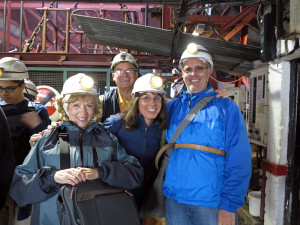 It is apropos to finish our visit to Wales with an in-depth look at the industry that had such prominence in Welsh history.
After being led to a room next to the mine shaft, men fit us with hard hats, and waist-belts with a battery pack, and a corded light to clamps on our hardhats. “Switch on your light,” says Dez, our guide, “and follow me.” Our group of twelve fills the cage and with my stomach doing a slight summersault, we step out into the mine shaft 90m down.
Standing in the dimly lit tunnel, Dez shares some facts, “In the 1940’s the mines were nationalized. In 1979 Margaret Thatcher closed down the mines in Wales, after 200 years of coal mining – her rational was they were not economically feasible. The outcry was apoplectic in proportion, with 20,000 workers out of a job. Coal has since been imported, supplemented by six privately owned strip mines still operating.” Big Pit was purchased by the workers and turned into a National Coal Museum and tours are run by volunteers, like Dez, who once worked in the mine.
Careful not to wipe-out on a patch of damp soil or smack our heads on low hanging beams, we make our way through the black walled tunnels. Dez stops and points to some iron drams (originally made of wood). “Whole families once worked 12 hour shifts to fill 4 of these drams each day, each holding a ton of coal – in order to afford the basics of food, clothes and shelter. Children started working as young as five years old. Their job was to man the wooden doors between mine sections, with only a candle for light. Children a few years older were used to pull drams through small tunnels to the shaft, until horses were utilized. The horses were brought down into the shaft at 4 years of age and did not leave for 9 years; many went blind from the continual darkness. Ten year old boys were assigned to take care of feeding and cleaning them, and the horses only worked 8 hour shifts, since the owner had to put out money to replace them.”
The mining families rented houses from the mine owners at such an atrocious rent that 20 or more people lived in two-room houses; conditions where cholera and other diseases just waited to happen. The mine also owned the stores where workers bought their food; in other words “they owed their souls to the company store”.
 In 1842 a Royal Commission made it illegal for women and children under age 10 to work underground, but some mine owners ignored this for another 20 years.
A cloudy sky never looked so good as when we resurface. A short walk takes us to the old mine offices that leave no page unturned in mining history and memorabilia – from the underground disasters that occurred, to electric lights replacing gas lamps, and equipment progressing to mechanical conveyors, cutters and loaders. Through the maze of rooms we see the Pit Baths that the worker’s wives fought for (since it was found wearing dust encrusted clothes home increased the likelihood of “black lung” disease). A small room used to treat injuries right up to the closing of the mine had only rudimentary first-aid supplies.
Most poignant is seeing a pair of old worn leather shoes, no longer than my palm from a once child miner, and walking past the rows of lockers with the names of their last users still on them. Keeping this history and memories alive is a great tribute to the coal miners and gives us a cultural understanding that words alone could not have portrayed. It was given UNESCO status in 2000.
We relish one more walk through the uplifting city centre before heading back to our hotel room to pack up for the next day’s flight from Cardiff to Belfast. Our amazing experience in Wales is not soon to be forgotten.
More information:
Big Pit: National Coal Museum
Free Entry
– Getting to Big Pit by bus:
Go to Central Bus Station Cardiff – Stand 3C
to catch Bus X3 to Cwmbran station (Stand “E”)
– go to Stand “F” for Bus #30 to Big Pit
(about a two hour trip)
– Getting back from Big Pit: take Bus #30 back to Cmbran Stand “F”
– go to Stand “B” to catch Bus 3X back to Cardiff